
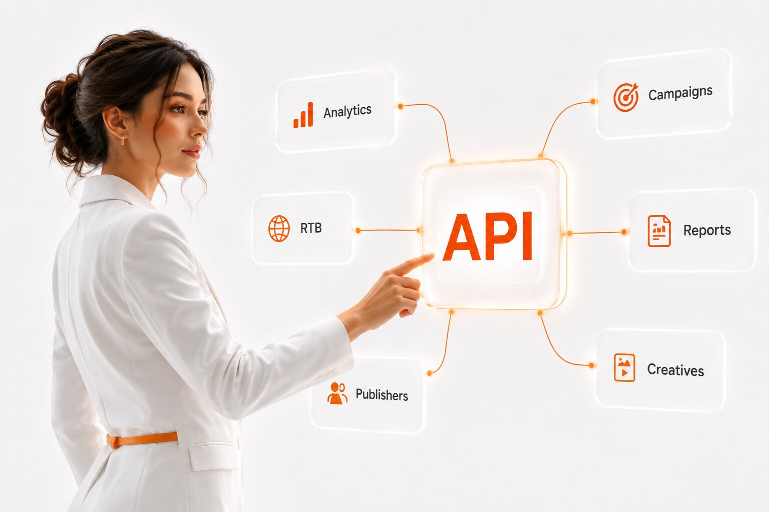
API is one of the most practical tools for anyone running traffic at scale. Whether you're an advertiser building your own automation, an RTB partner integrating with our platform, or a publisher managing multiple Ad Networks, API helps eliminate repetitive manual work and lets your own systems communicate directly with Trafficshop.
For many RTB clients, the API eventually becomes the primary way of working with the platform. Once the integration is complete, there is often little reason to log into the account on a daily basis. Campaigns, statistics and updates can all be handled programmatically. The account itself remains important for the initial setup and for certain features the interface.
Instead of downloading reports or clicking through multiple pages, you can request exactly the data you need. The Analytics endpoint supports a wide range of dimensions, metrics and filters, allowing you to build completely custom reports that fit your own dashboards, BI tools or optimization systems.
Need a report grouped by country, browser and hour? Easy.
Want to break traffic down by operating system, device type, publisher site, campaign, creative or one of three available SubIDs? No problem.
You can combine dozens of dimensions with metrics such as impressions, paid impressions, filtered traffic, returned traffic, clicks, CPM, CTR, advertiser spend or publisher revenue to build reports tailored to your workflow rather than adapting your workflow to a standard interface. Filtering is just as flexible.
API allows you to combine multiple conditions using AND/OR logic, filter by both dimensions and metrics, and sort the results however you like. For example, you can retrieve traffic from the US and Canada, only for Chrome and Firefox users, include campaigns with more than 1,000 clicks, and order everything by date and impressions. All within a single request.
One feature that often gets overlooked is timezone support.
Every analytics request can specify its own timezone. Instead of relying on a fixed reporting timezone, you can request statistics in UTC, Europe/London, America/Los_Angeles, or virtually any other supported timezone. Both the reporting period and hourly breakdown are automatically recalculated.
It may sound like a small detail, but anyone who has ever compared Trafficshop statistics with Keitaro, Voluum, BeMob, RedTrack or an internal BI platform knows how valuable this is. When every system uses the same timezone, comparing numbers becomes significantly easier, no manual calculations, no "missing hours," and no unnecessary confusion during reconciliations.
For teams building automated optimization, another important advantage is speed.
Under normal conditions, statistics become available through the API approximately 30 seconds after an impression occurs. This makes it possible to build near real-time dashboards, alerts and automated optimization rules without waiting for delayed exports.
The API is also designed to fit naturally into your own infrastructure.
Campaigns can be created, updated, paused and resumed programmatically. Banner and native creatives can be managed without opening the interface. Existing White Lists and Black Lists can be updated automatically by adding or removing traffic sources whenever your optimization logic requires it. While new WL/BL lists must still be created in the account interface, maintaining existing ones can be fully automated.
SubIDs deserve a special mention as well.
Trafficshop supports three independent SubIDs, giving buyers complete freedom in how they structure their tracking. Some teams use them for source IDs, others for placements, zone IDs, website identifiers or internal campaign references. Since the platform doesn't enforce a specific purpose, the same API can fit a wide variety of optimization workflows.
The API isn't just useful for advertisers.
Publishers can retrieve detailed information about their websites and channels, request ad codes or direct URLs, activate or pause channels, manage blocked advertiser domains, and access the same powerful analytics engine with custom dimensions, metrics, filters and timezone support.
At the end of the day, our API isn't meant to replace the Trafficshop interface - it complements it.
For smaller advertisers, the dashboard is often the fastest way to work. But as your traffic grows, your reporting becomes more complex, or your optimization becomes more automated, API evolves from a nice-to-have feature into the backbone of your workflow.
It's not a toy for developers.
It's a tool for anyone who wants to spend less time clicking buttons and more time scaling campaigns.
🧡